? ??????????????Vintage Ipod? ????? ?????? ???Rating: 5.0 (3 Ratings)??12 Grabs Today. 1817 Total Grabs. ?
?????Get the Code?? ?? ???????????????????????????Love Cures All? ????? ?????? ???Rating: 4.3 (8 Ratings)??27 Grabs Today. 2887 Total Grabs. ??????Get the Code?? ?? ?????Love Is All BLOGGER TEMPLATES AND TWITTER BACKGROUNDS ?
Showing posts with label ATC Collection.. Show all posts

Tuesday, February 23, 2010

Warli ATCs

The Warlis or Varlis are an Indian Scheduled Tribe. These indigenous people live in the talukas of Thane, Nasik and Dhule districts of Maharashtra, Valsad District of Gujarat[1], and the union territories of Dadra and Nagar Haveli and Daman and Diu[2]. They have their own beliefs, life, customs and traditions, which is the part of the Composite Hindu Culture. The Warlis speak an unwritten Varli language which belong to the southern zone of the Indo-Aryan languages, mingling Sanskrit, Marathi and Gujarati words. The word Warli is derived from warla, meaning "piece of land" or "field".

Their extremely rudimentary wall paintings use a very basic graphic vocabulary: a circle, a triangle and a square. The circle and triangle come from their observation of nature, the circle representing the sun and the moon, the triangle derived from mountains and pointed trees. Only the square seems to obey a different logic and seems to be a human invention, indicating a sacred enclosure or a piece of land. So the central motive in each ritual painting is the square, the cauk or caukat (pronounced "chauk" or "chaukat"); inside it we find Palaghata, the mother goddess, symbolizing fertility. Significantly, male gods are unusual among the Warli and are frequently related to spirits which have taken human shape. The central motif in these ritual paintings is surrounded by scenes portraying hunting, fishing and farming, festivals and dances, trees and animals. Human and animal bodies are represented by two triangles joined at the tip; the upper triangle depicts the trunk and the lower triangle the pelvis. Their precarious equilibrium symbolizes the balance of the universe, and of the couple, and has the practical and amusing advantage of animating the bodies.

The pared down pictorial language is matched by a rudimentary technique. The ritual paintings are usually done inside the huts. The walls are made of a mixture of branches, earth and cow dung, making a red ochre background for the wall paintings. The Warli use only white for their paintings. Their white pigment is a mixture of rice paste and water with gum as a binding. They use a bamboo stick chewed at the end to make it as supple as a paintbrush. The wall paintings are done only for special occasions such as weddings or harvests
(Source - http://en.wikipedia.org/wiki/Warli#Warli_painting)

The Warli paintings essentially depict the basic principals of life which are main theme or basis of any tribe. Their major designs include the harvest season,celebration, wedding, rituals and births. The Warli houses also see a pattern in decoration and designs. The Warli art has a special characteristic of representing the humble life of the Warli tribe.

Earlier Warli painting used to be etched out on walls of Warli houses, but nowadays, they are being painted on paper, vases, mugs, bedsheets, apparel too. This art is pretty popular all over India and the world as well. Simple and aesthetic in appeal, Warli Art painting is back and gaining much wanted fame and name.

I was always interested in warli paintings... i made my first warli painting During my MBA days, i learnt it from a dear friend who is a proffessional artist. well that was just a replica of one warli design.
After marraige when i was in Baroda i really got to learn what warli paintng is all about ... i attended a workshop on warli. and since then i m making warli paintings as and when possible. i have tried diff mediums and even colours for these. I will put up the pictures soon.

Here is just a glimps of 2 ATCs i made in warli ... Deepa has already picked these ATCs.
I have used handmade paper and green sketchpen.


Tuesday, June 9, 2009

Second series of ATCs

This is my second series of ATCs..
I have taken few symbols in indian culture and tried to paint them in abstract style. I used acrylic colurs with hard flat brush to give the strokes to get the desired look for surface.

1. Diya
Diya is a small earthen lamp that is lit especially at Diwali. They are usually made of clay. Ghee or oil is used as the fuel and cotton wool as the wick. Sometimes they are made by part filling a glass with colored water, Ghee is floated on top, and again cotton wool used as a wick. It is a tradition in India to light diya every evening in the house as it is considered holy and auspicious.

#2.1 picked by deepa

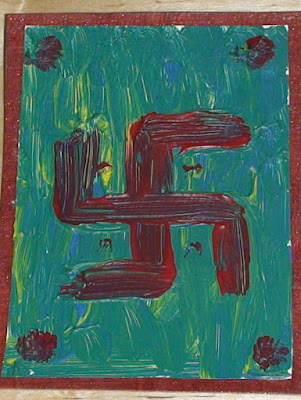
2. Swastika.
The swastika is an equilateral cross with its arms bent at right angles, in either right-facing (卐) form or its mirrored left-facing (卍) form. It occurs mainly in the modern day culture of India, sometimes as a geometrical motif and sometimes as a religious symbol. It symbolizes Harmony, Lord Ganesh has it on his right hand.
#2.2.1


#2.2.2


3. Aum / Om.
Aum (written in Devanagari as ॐ), is a mystical or sacred syllable in the Indian religions, including Hinduism, Sikhism, Jainism, and Buddhism.
It is pronounced as a long or over-long nasalized close-mid back rounded vowel . It is placed at the beginning of most Hindu texts as a sacred exclamation to be uttered at the beginning and end of a reading of the Vedas or previously to any prayer or mantra. The Mandukya Upanishad is entirely devoted to the explanation of the syllable. The syllable is taken to consist of three phonemes, a, u and m, variously symbolizing the Three Vedas or the Hindu Trimurti.
In Puranic Hinduism, Aum is the mystic name for the Hindu Trimurti, and represents the union of the three gods, viz. a for Brahma, u for Vishnu and m for Mahadev which is another name of Shiva. The three sounds also symbolize the three Vedas (Rigveda, Samaveda, Yajurveda).
(informations source : http://en.wikipedia.org/wiki/Aum)

#2.3

Al the four ATCs are available for trade.

Monday, June 8, 2009

My First ATC Collection!

Here is my first ATC collection....
I have chosen Lord Ganesha as the Theme for my first collection of ATCs.
As a person, i worship Lord Ganapati and i have tremendous belief in him. As this Atc is something new that i am doing, i chose to dedicate this collection to God Ganapati.
This is a Series (sets of ATCs that are based on one theme but that are different are called series)

1. Ganapati.
Ganesha or Ganapati is one of the best-known and most widely worshipped deities in the Hindu Pantheon. His image is found throughout India. Hindu sects worship him regardless of affiliations.Ganapti is considered as remover of Obstacles. Before starting a new things Ganesha is worshiped.Ganesha is considered to be the Lord of letters and learning. (More information on Ganesha is available here..http://en.wikipedia.org/wiki/Ganesha)
I have used acrylic colours and created form of ganesha.

#1 picked by deepa

#2 picked by deepa

#3
#4

ATcs No. 3 & 4 are available for Trade.

Artists Trading Cards!

The very basics of ATC:

As their name indicates, ATC are collectables, a brilliant idea born of the older sports-themed trading cards. The one rule that makes an ATC derives from their origins: the dimensions of the ATC must be 2.5"x3.5", or 64x89mm.

The ATC movement developed out of the mail art movement and has its origin in Switzerland.

To this rule are appended a couple of conventions. First, an ATC mustn't be sold, only exchanged, as the whole essence of these tiny works of art is about artists meeting (by correspondence or online if need be) and exchanging their works, thus meeting many artists and getting exposed to many personal styles.
Second, on the back of each ATC the artist writes part or all of the following information: name, contact information, title of the ATC and number (1/8, 2/8...) if it's part of an edition. By definition ATCs are made in limited numbers, often no more than one of a kind.
Unique ATCs are called originals; sets of identical ATCs are called editions and are numbered; sets of ATCs that are based on one theme but that are different are called series. Don't be intimidated by the concept of small editions or originals: very few people are anal about this. What most collectors really want are cards that were made with care. Based on that, numbers are meaningless.

After gathering the basic information from internet i am ready with my first collection of Atcs. i will put them in next post.

Source of Information :
1. http://www.cedarseed.com/air/atc.html
2. http://en.wikipedia.org/wiki/Artist_trading_cards

Related Posts with Thumbnails